I’m a Writer – But Am I “Aspiring”?

Oh, those labels we love to dole out, both upon ourselves and to other people.  And it’s not only in the publishing industry that we see this.  It happens all around us.  I started life as the “little brother” to two sisters.  Well, guess what?  I’m still the little brother when we get together, and I have grandchildren.

I started my professional career as a pharmacist: a graduate pharmacist first, then a registered one, and then a clinical one.  Those labels defined not only who I was, but it described in a single word what I had achieved.  After graduation, I had to endure grueling oral and written tests to become registered.  Then came an advanced degree and more arduous tests so that further adjectives could be attached to my job description: words like, clinical, infusion, nutrition support, homecare.  It was the right of passage into ever-smaller clubs of achievement.

When I chose to retire from pharmacy and decided that I was going to become a fiction writer, I thought I was done with labels.  I looked forward to being “just a writer” and spending my days devoted to creating art with words.  But reality crept in and the labels started to filter back.

“What type of writer are you?” I was asked.  “A novelist”, I answered.   That drew brief, knowing smiles since most knew I wasn’t yet published (Can we say “green”?!).  Okay, so I wasn’t yet a novelist.  I decided that I was simply an AUTHOR.  After all, I had finished a manuscript that was considered good.  But then I was told that I’m not an author until I’m published, that I’m only ASPIRING to be an author.  Okay, that finally made sense since I had been to a number of writing seminars and conferences and was learning more about the publishing industry and where I might fit into it.  That’s when I decided I’d have to be happy with just the “WRITER” label on my business card.

Then someone said I was only an ASPIRING writer because I hadn’t even published one word of fiction (professional, technical articles, yes; fiction, no).  So, in a few short months of my initial interaction with other writers, agents and publishers, I had been knocked down from novelist and author to someone who just ASPIRED to be a writer.  I was moving backwards fast!  That was when I drew a line in the sand and said enough with the labels.  I took a long, hard look at the footprint I was making in my writing career and asked myself some sobering questions.

What was I?  Was I nothing more than an enthusiast, someone just fascinated with writing, little more than a spectator or a collector?  I love model trains and used to collect them.  Was I just a collector of stories in the same way, writing in my spare time and then locking them away in a drawer?  That didn’t fit my ambition.  Maybe for a brief period I labeled my writing as a “hobby”, but I was definitely moving past that and beginning to think of it as a potential business.

After all, I write almost every day and don’t feel complete unless I manage to string some words together every 24 hours.  I’ve completed a manuscript that’s been professionally edited and which has been praised for both story content and writing skill.  And I’m beginning to fill what I call the “novel pipeline”, a second novel almost complete and two more outlined.

I don’t see myself as an ASPIRING WRITER.  I’m simply a WRITER, like so many others who work hard every day to improve their skills and who are searching for that publishing opportunity.  I gave up the ASPIRING part a long time ago.

I was ASPIRING when I just thought I might be able to write as well as the authors of some novels I enjoyed reading.  You could even say I was an ASPIRING writer during those first days of stringing words together on my computer.  Those stories were awful and I rewrote as much as I wrote, but I had hopes and dreams of accomplishing more.

Back then I meandered through two “almost complete” novels before deciding that no one should ever read them.  That’s when I began to take my new career seriously and invested in some writing courses.  I knew I had to educate myself in the art and business of writing just like I did years ago in the pharmacy industry.

I’m still not published, but I’m an accomplished writer (There goes another label.  It just slipped in!)  I have a manuscript that I’m proud of and my second one is polishing up nicely.  So, am I still an ASPIRING WRITER or have I progressed enough to simply say I’m a WRITER?

Thoughts?  Comments?  I’d love to hear them!

Posted in About Writing, What writers are called! | Tagged , , , , , , , , , , , , , | Leave a comment

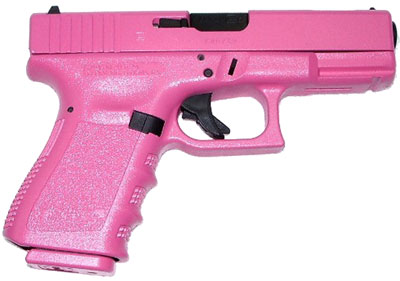
GUNS – The New Pink Accessory

In my limited expertise of what women love (that’s according to my wife), there are
many things that make a woman feel special: chocolate, the occasional flowers for no reason, chocolate, that special birthday card, chocolate, thoughtful jewelry, chocolate, a rub on the back, chocolate, a tender kiss for no reason, chocolate!  You get the message, but GUNS?

The NRA states that women represent the largest demographic increase in gun ownership over the past three years.  According to USA Today, gun retailers experienced a 61% increase in female shoppers between 2009 and 2010 alone.  And the National Sporting Goods Association reports that female target shooters grew over 46% between 2001 and 2010.  An October 2010 Gallup Poll identified that 23% of women owned a gun.

While those trends may be considered thought-provoking, the increased feminine interest in weaponry has sparked another trend:  If it shoots, it must be PINK.

Yes, PINK is the latest fashion in weaponry.  All things lethal must also be available in pink.  There are pink guns, pink ear protectors, pink shell pouches and (my favorite) the pink “Pistol Packing Princess” sticker for your car or home window.  There are even purses with pistol holsters as the perfect accessory for that special night out.

Gun and gun accessory manufacturers are scrambling to make their products more appealing to the female market segment.  Obviously, gray or black is no longer the color of protection, which is the primary reason a lady owns a gun.

We own guns for a variety of reasons but, statistically, the main reasons are for
protection against crime, target shooting and for hunting (in that order).  More women than men claim to own a gun for crime protection, whereas it’s nearly equal for men and women owning a gun for target shooting.  And more men report owning a gun for hunting than do women, but only by an 18% margin on average.

At any rate, I came upon this information recently and it fascinated me.  I know women carry pistols in their purses, but I’ve never seen a pink one.  As a writer, my first thought was that I would use a pink gun as the usual accessory for one of my characters.  I’m sure some of my friends who write crime novels are thinking the same thing.

Thoughts?  Comments?  I’d love to hear them.

Posted in Guns and Women, Pink Guns | Tagged , , , , , , , , , , , , , , , | 2 Comments

Fiction — A Believable Lie

Hi, I’m JAMES J. MURRAY

I’m that NEW WRITER, the one with fresh adventures of murder and international intrigue.  My novels often include the deadly trio of MURDER, MAYHEM and MEDICINE.

I’m from Louisiana originally but now live in South Texas.  Like most writers, I come from rich experiences that offer insight and depth into what I write.  I’m a clinical pharmacist specialist.  That means I know a lot about drugs: their origins, their therapeutic effects, their beneficial uses and even their misuses.  After years in direct patient care, I’ve recently freed myself from those responsibilities and now indulge in one of my other passions: FICTION WRITING.

We’re told that fiction is nothing more than a believable lie.  Basically, it’s an untruth.  Good fiction, however, is taking that untruth and reshaping it into something that resembles reality.  I love reading good fiction, so now I write it.  I’ll have done my job as a writer if after reading the last page of one of my stories you say, “Could that really have happened?”

This blog is to introduce myself and to build my platform so that you’ll become familiar with my writing style.  I’ll be posting new blogs regularly (once a week) and I’ll talk mostly about Murder, Mayhem and Medicine.  But sometimes I’ll add interesting information about my writing experience and at other times I’ll provide tidbits gained from my pharmacy background.  I promise to be interesting and fun!

Posted in About James J. Murray, Introductory Post | Tagged , , , , , , , , , , , | 4 Comments

The Medicine Cabinet and Kids – A Deadly Combo

Poison control centers across the nation recently celebrated the 50th anniversary of National Poisoning Prevention Week (March 18-24, 2012).  During that week, I read several interesting articles about child safety and home medications, and thought I’d share some of what I learned.

During National Poisoning Prevention Week,  a new initiative called “Safe Kids” was introduced.  In conjunction with that, Safe Kids Worldwide unveiled a new initiative called “Safe Storage, Safe Dosing, Safe Kids”.

Why all the extra focus by poison control centers on keeping kids safe?  (Glad you asked!!)  It’s because of some new statistics that spotlight the fact that poisons alone are not the only child safety issue in the home.  Those medications we stare at every day in the medicine cabinet potentially could pose an even greater risk.

EACH DAY approximately 165 kids are seen in emergency rooms after ingesting prescription medications.  That’s roughly four school busloads of kids!  An even more sobering statistic is that (of the children taken to emergency rooms for accidental medication overdoses) 95% swallowed the products while they were UNSUPERVISED.  Only in about 5% of the cases did it involve a caregiver making a dosing error.  What does that tell me?  It says that we as parents and caregivers are not doing enough to keep medications out of our children’s reach.

The Centers for Disease Control and Prevention reveals that, although the overall U.S. deaths due to poisoning among children plunged by half between 1979 and 2006, the percentage of those deaths from medications (both prescription and over-the-counter products) has nearly DOUBLED from 36% to 64%.  If a single factor for this growth in medication-related deaths were identified, the answer to this problem would be simple.  Unfortunately, solutions are rarely simple.  The reality is that these skyrocketing statistics are due to a multitude of factors.

They include:

1)   More available medications in the home

2)   Improperly stored medications at home

3)   Rising number of households with multiple generations, especially the elderly

4)   Unsupervised children (who just love to put things into their mouths)

5)   The natural curiosity of children, especially when medications look like candy

6)   Momentary or intermittent unsupervised periods (like a parent or caregiver going to the bathroom)

7)   Caregivers who mistakenly think “child resistant” packaging means “child proof”

8)   Thinking that “over-the-counter” (OTC) means the medication is not harmful in large quantities

So, if we look at all the possible reasons (and I’ve only listed a few here) for medication poisoning of children, we can understand that we could minimize some of the risks.  Let’s face it, children are curious.  They always will be and we should encourage that.  And children will always try to put things into their mouths.  Somehow youngsters think if it looks interesting, then it must taste good also.

What we can do is assure ourselves that where our children are and where we store our medications (both prescription and OTC) are two distinctly different places (and never the two shall meet).  Statistics show that we’re doing a good job of that with household cleaners and other sources of poisoning, but we’re not doing such a great job with the drugs we keep around the house.  The simple solution is to LOCK DRUGS AWAY.

Whether we have more medications around the house for whatever reason, whether the packaging is indeed tamper proof, whether the medication looks yummy and enticing, it won’t matter if we don’t remember to keep the medication out of the reach of our kids.  Simply by locking the medication out of sight does the trick.

When my children were young and inquisitive (still inquisitive but not so young now), the medications in our home were locked away in a toolbox and put up high in a closet.  By buying a metal toolbox, getting an inexpensive padlock and finding a nice hiding place (think hiding birthday presents), we can exponentially decrease the risks of kids getting into any medication.  The same advice goes to grandparents and other caregivers when our loved ones come to visit.  Remember, tragedy can happen in an instant (while we’re on the phone, while taking out the trash, etc), so be prepared and put some forethought into the potential dangers to our little visitors.

Thoughts?  Comments?  I’d love to hear them.

Posted in About Medications/Pharmacy, Drug Overdoses in Children | Tagged , , , , | 4 Comments